


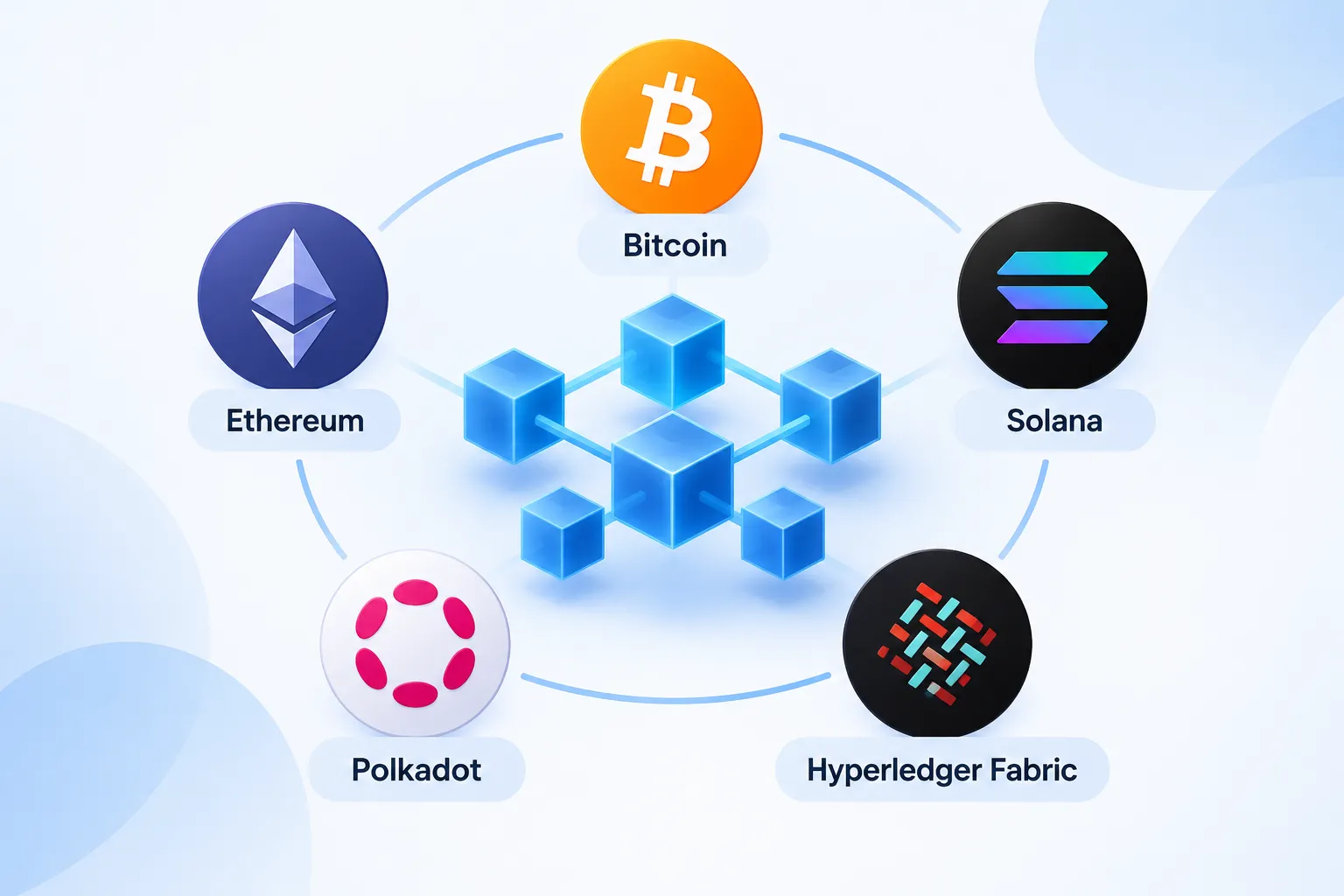
5 Key Blockchain Protocols You Need to Know
Blockchain protocols are the rules and frameworks that let distributed networks process transactions, keep records, and run applications. They shape speed, privacy, cost, and flexibility, so it pays to know how the major protocols differ before you commit to blockchain development. Digitalrooar walks through five of them below.
5 Key Blockchain Protocols You Need to Know
1. Bitcoin: Decentralised Digital Transactions
Bitcoin is the original public blockchain protocol, launched in 2009. Users send value straight to each other in a peer-to-peer model, with no bank in the middle. Miners secure the network through Proof of Work, spending computing power to validate transactions and add new blocks. Its main role is decentralised digital payments and value transfer, and its deliberately simple design has made it the reference point for every blockchain protocol that followed.
2. Ethereum: Smart Contracts and Decentralised Applications
Ethereum turned the blockchain into programmable infrastructure. Developers write smart contracts, which are self-executing code that runs on the network, and build decentralised applications (dApps) on top of them. Since 2022, it has used Proof of stake instead of mining. Common uses include DeFi and asset tokenisation, plus digital asset management, which makes Ethereum a frequent starting point for Web3 development and wider blockchain development projects.
3. Hyperledger Fabric: Enterprise Blockchain Solutions
Hyperledger Fabric, an open-source project hosted by the Linux Foundation, is a permissioned blockchain. Only identified, approved participants can join, and channels keep certain transactions private between selected parties. That control suits regulated, multi-party settings, so you’ll see enterprise blockchain solutions built on it for supply chain management and trade finance, along with wider business networks where privacy matters as much as trust.
4. Solana: High-Performance Blockchain Applications
Solana is a proof-of-stake network built for high throughput. It became known for Proof of History, a cryptographic clock paired with Tower BFT. In October 2026, its Alpenglow upgrade went live on mainnet and retired Proof of History from consensus, targeting finality of about 150 milliseconds. Teams choose Solana for DeFi and gaming, along with consumer-facing dApps where users expect instant responses.
5. Polkadot: Blockchain Interoperability
Polkadot takes a multi-chain approach. Its central Relay Chain provides shared security, while parachains are specialised blockchains that plug into it. Cross-Consensus Messaging (XCM) lets those chains exchange assets and data without relying on external bridges. Polkadot’s role is connecting specialised networks, so each one can focus on its own use case and still talk to the others, which is the heart of cross-chain interoperability.
How to Choose the Right Blockchain Protocol for Your Project
The selection of protocol is based on the needs of the project. According to Digitalrooar, the following aspects should be considered first:
- Application needs and business objectives.
- Speed and scalability of transactions.
- Privacy and accessibility of the network.
- Use of smart contracts.
- Integration and interoperability needs.
Public and permissioned networks have their own needs as well. Public networks like Bitcoin and Ethereum are fit for transparent applications, while permissioned networks like Hyperledger Fabric are fit for business purposes.
Build Your Blockchain Solution with Digitalrooar
Digitalrooar is a technological company that provides blockchain and Web3 development services. If you’re looking into decentralized apps or enterprise-level blockchain technology, tell us about your project and discuss what protocol will suit best.
Conclusion
Understanding what each protocol does well helps businesses make informed technology decisions when planning blockchain applications. Digitalrooar is ready to help you take that first step.
Related Blogs
Contact Us
Let’s Create Big Stories Together
We have stood the test of time, and built some of the finest mobile apps for over 100 clients around the world.
REQUEST A QUOTE-
INDIA
A 329-330, Money Plant High Street, Jagatpur Road, S.G. Hwy, Ahmedabad - 382470
-
UAE
FLRG - 05 GF, ibis World Trade Centre, Sheikh Zayed Rd, Trade Centre 2, Dubai - United Arab Emirates

What our clients say
We were looking for the company that was professional as well as provide us the complete solution starting from logo design to digital marketing. Would surely recommend Digitalrooar, it’s a one-stop destination.
I would like to thank the whole team of Digitalrooar for completing my project before the deadline. They are professional, qualified as well as know how to prioritise the work.
Contact Us

AUSTRALIA
Suite 4894, 903/50 Clarence Street Sydney NSW 2000

INDIA
A 329-330, Money Plant High Street, Jagatpur Road, S.G. Hwy, Ahmedabad - 382470

UAE
FLRG - 05 GF, ibis World Trade Centre, Sheikh Zayed Rd, Trade Centre 2, Dubai - United Arab Emirates
Request a Quote
Please take a quick moment to complete this form and our business representative will get back to you swiftly.