

AEO vs SEO: What Changes in AI Search and What Still Matters
A few years ago, success in search was measured by one thing: ranking on the first page of Google. Today, the search experience looks very different. Users ask questions directly to ChatGPT, Perplexity, Gemini, or Google’s AI Overviews and often receive a complete answer before clicking a single website. Naturally, this has led many businesses to ask the same question:
Is SEO still enough? Or is AEO the new SEO?
The short answer is neither.
AI has undoubtedly changed how people search, but it hasn’t changed what search engines and AI systems need to deliver trustworthy answers. In fact, Google itself states that the same foundational SEO best practices continue to apply to AI-powered experiences like AI Overviews and AI Mode. There’s no separate “AI SEO” checklist or special optimisation required.
The real shift isn’t from SEO to AEO. It’s from ranking pages to becoming a trusted source of answers.
Search Has Changed, But User Intent Hasn’t
The way people search has evolved significantly, but the reason they search hasn’t changed. Whether someone types a keyword into Google or asks ChatGPT a detailed question, they’re still looking to solve a problem. They want reliable information, want to compare options, make informed decisions, or find the right product or service.
What has changed is the way those answers are delivered. Instead of presenting users with a list of blue links, AI-powered search experiences aim to provide direct, conversational responses by pulling together information from multiple trusted sources.
For businesses, this doesn’t mean abandoning their existing SEO strategy or creating an entirely new marketing approach for AI. It means strengthening the fundamentals that already work while making content clearer, more structured, and easier for both search engines and AI systems to understand and reference.
Rooar Perspective
AI hasn’t changed why people search. It’s changed how they discover trustworthy information.
SEO vs AEO: What’s the Real Difference?
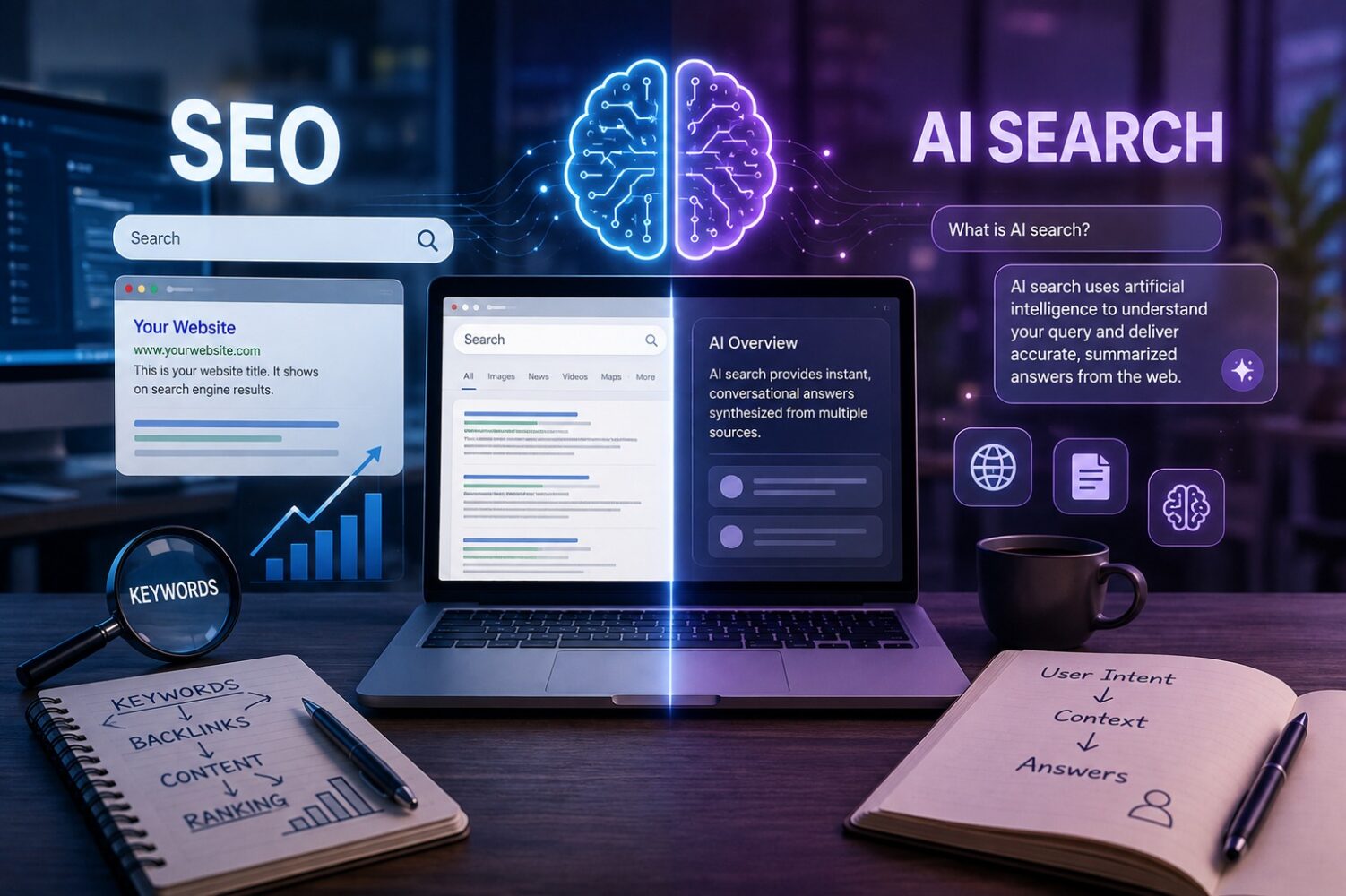
Although the terms are often presented as competitors, SEO and AEO actually complement each other.
| SEO | AEO |
| Optimises web pages for search engines | Optimises content to become part of AI-generated answers |
| Focuses on rankings and organic traffic | Focuses on citations, mentions, and answer visibility |
| Targets keywords and search intent | Targets questions, entities, and conversational queries |
| Drives website visits | Builds authority across AI-powered search experiences |
Think of it this way:
SEO helps search engines find your content; meanwhile, AEO helps AI systems understand and trust it. Without strong SEO fundamentals, there is very little for answer engines to discover in the first place.
What AI Search Has Changed
While SEO continues to provide the foundation for online visibility, AI-powered search has changed how content is discovered, interpreted, and presented to users. Instead of focusing solely on matching keywords with webpages, AI platforms aim to understand intent, generate comprehensive responses, and reference information from multiple trusted sources. As a result, businesses need to think beyond traditional rankings and create content that is informative, well-structured, and genuinely useful.
Conversations Have Replaced Simple Keywords
Search behaviour has become far more conversational than it was a few years ago. Rather than typing short phrases like “best CRM”, users are now asking detailed questions such as, “Which CRM is best for a growing B2B SaaS company with a small sales team?” This shift means content needs to address complete questions, provide meaningful context, and offer clear, practical answers instead of being written solely around individual keywords.
Visibility Goes Beyond Rankings
Securing a top position in Google’s search results remains valuable, but it’s no longer the only measure of visibility. AI-powered search experiences often generate answers by referencing information from multiple credible websites. Being cited within an AI-generated response can be just as valuable as ranking first because it positions your brand as a reliable source of information before users even begin exploring different options.
Authority Has Become More Important Than Ever
AI doesn’t usually rely on a single webpage to generate an answer. Instead, it evaluates information from multiple trusted sources, looking for consistency, credibility, and expertise. This makes topical authority, original insights, and trustworthy content more important than simply publishing a higher volume of articles. Businesses that consistently demonstrate experience and expertise are better positioned to earn visibility across both traditional search results and AI-powered search experiences.
What Still Matters (More Than Ever)
One of the biggest misconceptions surrounding AEO is that businesses need an entirely new optimisation strategy. Google says otherwise.
Its official guidance confirms that the same SEO fundamentals remain essential for visibility across both traditional search and AI-powered experiences.
| Still Matters | Why It Matters in AI Search |
| Helpful, people-first content | AI systems favour content that genuinely answers user questions. |
| Technical SEO | Pages still need to be crawlable, indexable, and accessible. |
| Internal linking | Helps search engines and AI understand topical relationships. |
| Structured data | Improves context and supports search understanding. |
| E-E-A-T | Demonstrates experience, expertise, authority, and trust. |
| Brand authority | Trusted brands are more likely to be referenced across the web. |
Marketing Insight
This is exactly where many businesses struggle. Publishing more blogs isn’t a strategy. Building topical authority is.
A modern digital marketing strategy combines technical SEO, content marketing, website optimisation, digital PR, and structured information architecture to help brands earn visibility across both search engines and AI-powered discovery platforms.
That’s the approach we take at Digitalrooar through creating search strategies designed not only to improve rankings but also to strengthen long-term brand authority.
What Businesses Should Stop Chasing
As AI search grows, so do the myths.
Fortunately, Google has addressed many of them directly.
You don’t need:
- Special AI-specific schema
- llms.txt files for Google Search
- AI-only content formats
- Keyword-stuffed conversational writing
- Separate “AEO pages”
Instead, Google recommends focusing on valuable, original content supported by strong SEO fundamentals.
Is Your Search Strategy Ready for AI?
Before worrying about AEO, ask yourself:
- Does your website answer real customer questions?
- Is your content built around topics instead of isolated keywords?
- Can search engines easily understand your website structure?
- Does your brand demonstrate expertise and credibility?
- Are you creating original insights instead of repeating what’s already online?
If the answer to several of these questions is “not yet,” the opportunity isn’t to abandon SEO. It’s to improve it.
The Bottom Line
The future of search isn’t SEO vs AEO. It’s SEO strengthened by AEO principles.
Businesses that continue treating SEO as nothing more than keyword rankings may find themselves losing visibility as AI-powered search evolves. On the other hand, brands that invest in helpful content, technical excellence, topical authority, and genuine expertise are far better positioned to succeed regardless of how people search.
At Digitalrooar , we help businesses build future-ready search strategies that work across both traditional search engines and AI-powered experiences. From technical SEO and content strategy to authority building and AI-ready optimisation, our focus remains the same: helping brands stay visible wherever their audience searches next.
Related Blogs

Ecommerce SEO Checklist for Australian Online Stores
With more Australian shoppers starting their purchase journey on Google than eve...
How Traditional SEO Gets Benefited by Artificial Intelligence
As an agency owner, you must be well aware of how important it is to have reliab...

Understanding UTM Parameters and How to Track Them in GA4
You have invested your money, time and energy in your marketing campaigns and fe...
Contact Us
Let’s Create Big Stories Together
We have stood the test of time, and built some of the finest mobile apps for over 100 clients around the world.
REQUEST A QUOTE-
INDIA
A 329-330, Money Plant High Street, Jagatpur Road, S.G. Hwy, Ahmedabad - 382470
-
UAE
FLRG - 05 GF, ibis World Trade Centre, Sheikh Zayed Rd, Trade Centre 2, Dubai - United Arab Emirates

What our clients say
We were looking for the company that was professional as well as provide us the complete solution starting from logo design to digital marketing. Would surely recommend Digitalrooar, it’s a one-stop destination.
I would like to thank the whole team of Digitalrooar for completing my project before the deadline. They are professional, qualified as well as know how to prioritise the work.
Contact Us

AUSTRALIA
Suite 4894, 903/50 Clarence Street Sydney NSW 2000

INDIA
A 329-330, Money Plant High Street, Jagatpur Road, S.G. Hwy, Ahmedabad - 382470

UAE
FLRG - 05 GF, ibis World Trade Centre, Sheikh Zayed Rd, Trade Centre 2, Dubai - United Arab Emirates
Request a Quote
Please take a quick moment to complete this form and our business representative will get back to you swiftly.